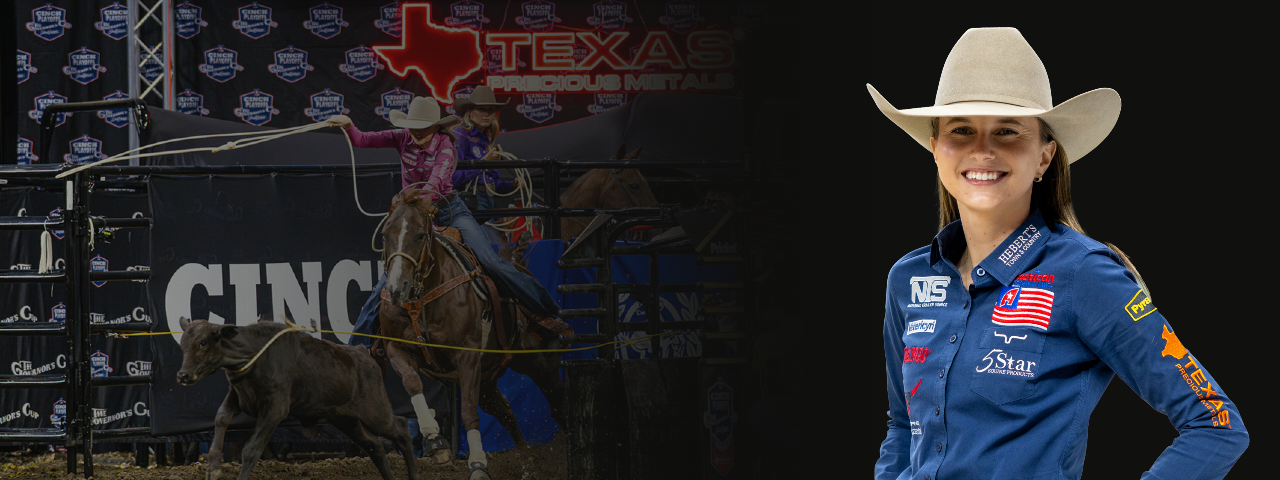
When Josie Conner was 16, she was running 10 to 20 calves a weekend across three jackpots, each with $10,000 in added money. Breakaway roping was booming, and the teenager from Iowa, Louisiana, was averaging about $200,000 a year before she had ever entered a professional rodeo.
Her parents noticed. They sat her down.
“If this is what you’re gonna do, you have to break the mold,” they told her. A lot of people who rodeo successfully, they explained, come out of it with nothing. She would treat it like a business; everything would be documented, and she would plan for the day the money stopped coming as easily.
“If this is what you’re gonna do, you have to break the mold.”
— Josie Conner
Conner is now 23 and one of the standout athletes in professional breakaway roping, with more than $600,000 in WPRA earnings alone. But she has followed her parents’ advice. She invests for the future, recently graduated from McNeese State University with a degree in business, and treats her career like a business. At the same time, she continues to win. At the 2026 CINCH Playoffs Governor’s Cup in Sioux Falls, South Dakota, Conner posted a 1.7-second run before winning breakaway roping on the final night with a 1.9.
Two Seconds
For anyone who has never watched it, breakaway roping is the fastest event in rodeo. Conner calls it the women’s version of tie-down roping. The roper sits on her horse in the box, nods, and the calf is released. She chases it down, ropes it, and the rope, tied to the saddle with a piece of nylon string, breaks away. The clock stops. A great run is two seconds or less.
At that speed, tenths of a second decide everything. At the Governor’s Cup, Conner explained, a 2.0 might win $12,000 in a round while a 2.2 might place third for several thousand dollars less. Most of that margin comes from the start. Conner holds her reins lightly, then makes a small drop of her hand paired with a squeeze of her legs, one fluid motion, and her horse leaves the box.
In the moments before, she follows the same routine. The saddle tightened so many ropers out. Rope set. A few looks at the start. Hat pulled down, powder on. She almost never watches the roper right before her. When she rides into the box, the crowd noise disappears. She will not hear the announcer. But if Riley or her dad says something, she hears it. Then she says a prayer for safety, and to shine to the best of the ability God gave her.
The Horse is 80 Percent
Conner gives most of the credit to the animal underneath her. Her horse, Dutch, is a two-time AQHA Breakaway Horse of the Year, and she jokes that he is more famous than she is. He is 17. When an injury kept him home at the start of the 2026 summer run, she worried. A seven-year-old mare she had bought stepped up, and Conner heads into the new season with both.
She does not train young horses. She prefers veterans who know their job, and she believes the great ones are born that way. Her work is the partnership: feeding, bathing, riding, and learning what each horse needs. Dutch gets red-light and magnetic therapy blankets. The mare needs to be ridden down. “You have to be a great team,” she says.
In Every Loss, There is a Win
A rodeo athlete can drive hundreds of miles for a two-second chance and come home with nothing. Conner handles it with film. Nearly every run, practice included, is recorded, so she does not have to guess what went wrong. She watches, finds the mistake, and moves on. “There’s no point in dwelling,” she says. “You’ve got to get back in the truck and do it again.”
It helps that she never travels alone with a support system that understands exactly what the job requires. Riley Webb, her fiancé and a three-time NFR tie-down roping champion, is beside her more than 200 days a year. Her father, who roped professionally and has coached her all her life, now helps them both. The couple jokes that when one of them wins, the other probably will not.
Building for the Long Run
Conner has a love-hate relationship with social media. She knows sponsors need the posts and sees herself as her own brand, but she is clear about the order of things: “We wouldn’t be known on social media if we weren’t good at what we did,” she says. The roping comes first.
She hopes breakaway roping will one day compete inside the Thomas & Mack Center during the NFR, and if not, that the prize money will catch up. She looks about five years ahead and hopes to have a gold buckle or two by then. Beyond that, she says, it is in God’s plan.
Watch Josie Conner explain the speed, the horses, and the money lessons behind her career on Episode 51 of Y’all Street.