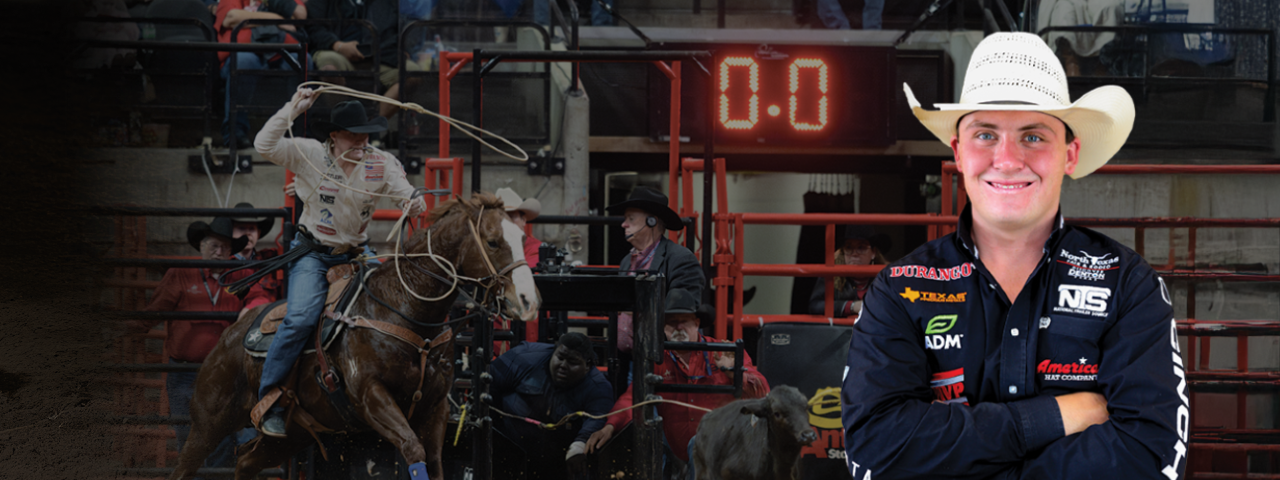
Ep. 23: Riley Webb – 2× PRCA Tie-Down Roping World Champion
Tarek sits down with the three-time World Champion to discuss how he became the youngest athlete to break $1 million in career earnings. They dive deep into the logistics of life on the road, the economics of "horsepower," and the mental fortitude required to dominate the dirt.
In this episode...
- Tie-Down Roping fundamentals and rules.
- The economics of Professional Rodeo (PRCA).
- Mental resilience and sports psychology.
- Personal Branding and Social Media for Athletes.
At 22, most people are just entering the workforce. Riley Webb is busy shattering the financial ceiling of professional rodeo. In this episode, Tarek sits down with the three-time World Champion to discuss how he became the youngest athlete to break $1 million in career earnings. They dive deep into the logistics of life on the road, the economics of “horsepower,” and the mental fortitude required to dominate the dirt.
Key Takeaways
- The “Baseball vs. Rodeo” ROI: At 11 years old, Riley crunched the numbers. He realized the statistical probability of making a living in rodeo was higher than in the MLB. It’s a lesson in early self-awareness and playing to your advantages.
- Short-Term Memory is a Business Asset: In a sport where you compete daily, dwelling on a failure costs you money tomorrow. Webb explains his “short-term memory” protocol—analyzing the error on video, fixing it, and immediately flushing the emotion to protect the next run.
- Horsepower as Asset Management: Webb treats his horses like six-figure machinery. He discusses the strategy of having an “A-Team” horse (Rudy) for high-paying gigs and a solid “B-Team” for smaller circuits to preserve the asset’s longevity.
- The Hidden Overhead of Rodeo: It’s not all profit. Webb breaks down the reality of the “burn rate”—fuel, entry fees, vet bills, and the cost of hauling a custom Cimarron trailer across the country to chase a gold buckle.
Notable Quotes
“I’m not chasing anybody… I want to be in consideration of being the greatest of all time. I want to show up every year, every day, give it all I got. If I gave 110% every time… I won’t have no regrets.” – Riley Webb
“A lot of people don’t see the struggle, the grind… They see the 10 nights on TV and think, ‘Oh, that’s easy.’ They don’t see the all-night drives, roping at 7 a.m., slack, making a bad run, and driving all day to the next one.” – Riley Webb
“I view it as a job… I’m putting all this money out there—horses, trucks, trailers—to get down the road. I got to show up and be locked in.” – Riley Webb
Mentioned Resources
- Texas Precious Metals: The creator of the Riley Webb signature silver round.
- Cimarron Trailers: Riley’s preferred transport for life on the road.
- Roy Cooper, the “Super Looper” and rodeo legend, is mentioned as an early influence.
- 7K Roping Dummy: The tool Riley uses for stationary practice.
0:00 - 0:38
Tarek: Two years after high school, you qualify for National Finals Rodeo in 2022, the same year that you are like the resist all rookie of the year. In 2024, you broke 1 million in career earnings. Just this weekend, you just broke the record, the single season record for earnings. I think it was 300,000 pre National Finals Rodeo earnings. You're 22 years old. You're making millions. You're a world champion. Welcome to Y'all Street. Today, I speak with Riley Webb, the two-time world champion, tie-down roper. Riley, would you like a cup of coffee?
0:38 - 0:39
Riley: Yes, sir.
0:39 - 0:44
Tarek: I got you this Ain't My First Rodeo mug since you've been traveling all over.
0:44 - 0:45
Riley: That's awesome. That's awesome.
0:45 - 0:48
Tarek: Coffee cheers, brother. Yes, sir. It's been a long time coming.
0:50 - 0:54
Riley: It has been. It's been, what, almost a year now?
0:54 - 0:55
Tarek: Yeah.
0:56 - 0:57
Riley: And you've been- Finally got to meet in person.
0:57 - 1:13
Tarek: I know. After all those texts and following you all year, you've had a phenomenal year and you've been traveling all over the place. So walk me through the schedule, especially for people listening. What is the schedule like for a rodeo veteran like you?
1:13 - 2:46
Riley: I don't know about a veteran, but I've been a couple of years. This is my fourth year out here rodeoing. Yeah, so the season starts actually October 1st of last year. So in 2024, it actually started the 2025 season, October 1st. And there's only a couple of rodeos for the regular season before the NFR for the next year. So it kind of overlaps a little bit. So the NFR is in the first week of December. So after the first week of December last year, got home a couple of weeks off. The NFR, I mean Christmas, I mean, sorry. And then the New Year's, and then we start back the San Diego rodeos in January. And then all the major buildings, Denver, Fort Worth, San Antonio, Houston, they're all going on in Texas. So we go to those, pretty close to the house, being from Texas in the wintertime. And then June rolls around and everybody's headed out for the summer run. And so when I left the first week of June, I just got back last week, was home for four days since we left the first week of June. So June, July, August, September, half of September, we've been gone out there rodeoing, trying to win and stay in the top 15. We're trying to win a gold buckle. So most of the year we've been number one in the world. So that's been huge. So we got home a couple of days last week, practiced up, got everything, got the truck and trailer cleaned up, everything ready to go to get back out here to Sioux Falls. And this is the last one of the 2025 regular season. And it's gonna have substantial changes in the PR state world standards before we go to Vegas.
2:46 - 3:49
Tarek: There are big ramifications. This is a rodeo that has a huge purse. So we're in South Dakota for Governor's Cup. And last night was the first night. You took second on the night, which is a nice little payout there. And for those listening, the way that professional rodeo works is, the guys go around, all these end girls go around all these events and they win prize money. And the prize money is accrued throughout the year. And on September 30th, is that the cutoff? Yes. They take the top 15 and those top 15 earners are able to go to National Finals Rodeo in December. So your season, as you said, goes from October all the way to September and with very few breaks. So I wanna get into that a little bit. What is life like for you because you're on the road nonstop and you say, we go here and we go there. Who's going with you? How are you traveling? What are you traveling in? Are you staying in hotels? You staying in a camper? What is the routine?
3:50 - 4:18
Riley: Yes, sir. So I got in a NTS Cimarron trailer. It's got 11 quarters in this front part and then where I put the horses in the back. So it's got a shower, microwave, fridge, a bed, couch. So it's pretty nice to be able to go up and down the road in that. And so, yeah, so it's hooked onto my truck and we're able to pull it down the road, load the horses up and then able to get somewhere and plug it in. It's just like an RV, but able to put your horses in it and haul them down the road.
4:18 - 4:20
Tarek: How many horses are you bringing with you at any time?
4:20 - 5:23
Riley: So my trailer is a four horse trailer, but usually I'm taking two to three horses at max, max at the time. So usually for me, it's two sometimes. So I have my girlfriend, Josie Connor, she's a breakaway roper. She might come with me sometimes and or have another, you know, like this year Shane Hancey went with me for a couple months and so he had his horse in there with me. So most of the time it's three at max, it's four if we are really, really have to load up and go somewhere and get stuff moved around. But yeah, so it's, we're in a RV on wheels with the horses loaded up and yeah, the summertime's the busiest part of time of the year. You know, where people don't realize you, you know, rope at even a 7 a.m. slack, drive somewhere, rope that night in a performance and then drive all night to rope at a slack the next morning. And a slack is like a performance. It's not a performance where the stands are gonna be packed, a bunch of fans. It's kind of like, there's not gonna be very many people in the stands, nobody really around, just kind of like the overflow of people not in the performance, if that makes sense.
5:23 - 5:27
Tarek: I see, I see. And so there are times then that you're traveling alone?
5:28 - 5:48
Riley: Yes sir, there's sometimes. So most of the time, so usually I try to have a buddy or a helper help me drive down the road. So maybe that they won't be competing but their job is just to help me drive, get down the road and take care of the horses. So I have a little bit of help and get some sleep if we gotta go, you know, all night, drive a couple hours and then let them take over and I get some sleep, but.
5:49 - 5:50
Tarek: Gosh, so you've been just driving all over the country?
5:50 - 5:51
Riley: Yes sir, yeah.
5:51 - 5:57
Tarek: And what do you listen to when you're in the truck? You listen to music or a podcast or what are you listening to?
5:57 - 6:37
Riley: A little bit of everything, you know, try to listen to some music, listen to some podcasts, kind of a football fan, like watch some football, but baseball if it's on. A basketball season is about to start back up but we'll be home. So that'd be nice to be home and chill and get to practice, get ready for the NFL and watch basketball kickoff. But yeah, going down the road, just it's busy. We're, so trying to get rest, make sure the horses are, we got a good spot to lay over, not have to, if we're going a couple hours, need a spot to lay over, make sure we got a good spot to lay over, keep the horses, get a good night's rest, you know, in a safe spot and be able to get up and go back at it the next day.
6:37 - 6:56
Tarek: So for the horses, I have to think, you know, it's gotta be tough on them, you know, as far as the travel goes too. I mean, when you talk about stopping and laying over, are you getting, are you looking for places specifically where they go and kind of stretch their legs a little bit and get out or is that tough or are there kind of preset locations when you're on tour that people typically go to?
6:57 - 7:47
Riley: Yes, sir. There's kind of pre, I mean, now, so it's my fourth year rodeo. So now I kind of, first year was really hard. I'd never been out there before. I was kind of trying to find good places. Some people tell me, you know, this is a good place to stay and stuff like that. But until you're out there and find the spots that work for you and it's easy. So now I kind of have, if we're going that route, I kind of know a couple of places where I would want to stay over. All right, the next morning, there's a good truck stop right by this where we're gonna keep the horses and good sandy pins where they can get out and roll and run around and stretch their legs out. And then I'll be able to, all right, I'm gonna be able to fill up at that truck stop and get right back on the interstate. So now I kind of have it pre-planned and kind of know where I kind of want to go and where I want to stay if we're traveling. But yeah, a lot of the fairgrounds are nice too where we're going to the rodeos that they're very hospitable and welcome us in and have a good place for us to stay as well.
7:48 - 8:03
Tarek: Yeah, is it tough being on the road so much just maintaining relationships and friendships? And you mentioned you have a girlfriend who's also in rodeo. Are you typically at the same rodeos or different across the country? Like what's that experience like for you?
8:03 - 8:46
Riley: Yes sir, it's difficult sometimes. The summertime, it's totally different than any part of the year because the schedules, the slacks are different days. The performances might be offset a little bit. Like the breakaways might have a standalone. So they're having the Wrangler National Finals and they're in Sioux Falls and stuff like that. But sometimes not every rodeo has breakaway yet. So sometimes the schedules don't just line up perfect. But yeah, the summer, it's a little give or take. Most of the time we can be, try to enter at the same time, be at the same performance that day. And then sometimes it don't work out. So that's why we don't get to go full-time together yet because it's just hard to schedule when we're both trying to be at the top of our game and rope for a gold buckle.
8:46 - 10:23
Tarek: Yeah, there's a lot there. And I want to get into some of your background, but first I want to just kind of read through this list of accomplishments that I dug up here. So you started roping when you were six. That's a whole line of questions there alone. But you, it says here in 2020, you were the National High School Rodeo Tie Down Champion. You started doing pro rodeo when you were around 15 years old. Two years after high school, you qualify for National Finals Rodeo in 2022, the same year that you are the Resist All Rookie of the Year. You're the National Finals Champion, National Finals Rodeo Champion in 2023 and 2024. In 2023, you earned almost half a million dollars in bribes money. In 2024, you broke 1 million in career earnings. Just this weekend, you just broke the record, the single season record for earnings. I think it was 300,000 pre-National Finals Rodeo earnings. You're 22 years old. You're making millions. You're a world champion. You are, you have a huge following. What is that like? I mean, it's, I'm thinking about myself at 22 years old. I'm graduating from college. Most people your age are trying to figure out what they want to do in life. And here you are, you've already risen to the top of your game. Do you ever sit back and just kind of shake your head a little bit and think, wow, I can't believe I'm here?
10:23 - 11:44
Riley: Yeah, it's crazy to think that. Me and my mom were talking yesterday and she was like, did you ever think that you were going to be this good? Like, and I was like, well, yes and no. Everybody dreams of, all right, I've been roping my whole life. So obviously this is my goal. I would want to be the world champion. I want to be at peak performance every, you know, when I was able to turn 18, buy my car and be a professional. But to actually be able to do it at a young age and to be at the top of my game right now and have the horses and the companies like you, y'all, and to back me and support me. And it's just a dream come true to get to make a living roping and doing what I love every day. I'm very, very blessed to be 22 years old and get to wake up and do what I love to do every day. But yeah, it's crazy to think that that's possible, you know, to think that I'm a two-time world champion already, potentially have a chance to go back this year and, you know, three-peat. And some people, you know, their whole career have it, don't even get one world championship to be, so to be 22 years old, to have a chance to have two and then have a chance again, it's a dream come true. It's kind of leaves me speechless because it seems too good to be true, really, because I'm just so blessed.
11:45 - 12:09
Tarek: And it makes me wonder since you, I mean, you've already ascended to the top of your profession. When you sit at home and you think about your hopes and dreams and what you're aspiring to, is it to just continue every single year being a world champion? Is it, you know, are you looking for a hall of fame career? Do you want to set records? What is motivating you now that you're at the top?
12:10 - 13:33
Riley: Yes, sir. I think just the process, enjoy the process and try to get better each day, you know. Try to be the best version of myself I can every day, get, you know, 1% better each day and just keep stacking those good practice sessions, the good runs and consistent. Consistent and I look at it, I'm not even full developed in my game yet, you know what I mean? I'm 22 years old. My mind's not even as strong as it's going to be when I'm 25, 26 years old. So just keep the good practice sessions, keep a good head between my shoulders and try to stay consistent. And I think that's a huge part, consistency over the year. A lot of people don't see the struggle, the grind throughout the summer months or they just see, all right, the Sioux Falls is on TV this week and the Wrangler National Finals is on TV. They see that and they're like, oh, that's easy. They're making 30,000 a night in those 10 nights. You know, that's awesome. They don't see the all night drives, drive all night, get up and rope at 7 a.m. Don't make a good run and then you have to drive all day to the next one and to have the mental stability and be able to do that over and over again.
13:33 - 13:43
Tarek: Just dealing with the exhaustion, you know, not getting a great night's sleep every night and dealing with horses who can be difficult from time to time, so.
13:43 - 14:21
Riley: So many variables that go into our sport, but I kind of got off your question, but yeah, just to be the best I can be every day and potentially if I gotta, you know, try to be the best in my event when I'm done. I want people to, I wanna be in consideration of being the greatest of all times and I'm not chasing anybody. And if I don't, I just wanna show up every year, every day, give it all I got and whatever comes out of that. I know when I'm done roping, if I gave 110% every time I showed up, every day I went to the practice pen, that if I gave it all I got at the end of my career, I won't have no regrets.
14:21 - 14:44
Tarek: So pro rodeo is kind of interesting because you run into the same competitors almost at every single event. And I'm curious what that dynamic is like because certainly there are rivalries, but is there, do you have relationships with the people that you're competing against? Are they your friends? Do you not talk to each other? Do you give each other like the stare down right before the event? Like, how does that all work?
14:45 - 15:44
Riley: Yes, sir. So like my rookie year, I went by myself and had a buddy driving me. And then my second year, I had a good buddy of mine, Dylan Hancock. He won the rookie of the year that year. So he was my good buddy. He went with me. So we, I mean, we're not a team, but at the same time, we're pulling for each other. We're in the all night drives together. We're in the trenches together every day. So yeah, we are kind of a team, you know? But at the same time when he goes seven, three, I want to beat him seven, two, and the vice versa, whatever. And then the next year, him and Cole Clemons got to go with me. So there was three of us in a rig going, but yeah, we, obviously I want to do better than them. They want to do better than me, but at the same time, we want the best for each other. So yeah, I think too. So this last year, I went by myself a little bit and Shane, he's a veteran, 15 time NFR qualifier. So that was cool to go with him and a lot of experience that he had and kind of, we got to rub shoulders and compare.
15:45 - 15:48
Tarek: Do you share notes? Do you coach each other or you need to do this or you need to do that?
15:48 - 16:51
Riley: A little bit, yes, sir. I mean, we're both kind of know what we're doing. But we see little things and we ask and try to pick up on each other and stuff that we don't see or feel during our run. But yeah, you see a lot of the same people at the rodeos. You're roping against them all year long. I think at the beginning of the summer, everybody's ready, excited. All right, let's go. Everybody's got big hopes and dreams at the beginning of the year. And then it gets down to August, September, at the end of the year, when the standings start tightening down. I think it gets a little bit more serious for guys and- More pressure. Exactly, not wanna, not chat as much, which I'm not, I like to show up, do my job and go to the next one. A lot of people don't look at this as a job, but that's how I got to look at it. Putting all this money out there, trying the horses, the trucks, the trailers to get down the road and spend my whole year out there driving. So I got to show up and be locked in, dialed in and do my job and then go the next one and do it again.
16:52 - 17:12
Tarek: Are you doing anything physically to keep up with the demand? I mean, when I think about traveling in a truck or long distance, you're stopping at gas stations and maybe the food that you're eating isn't the best and you're not getting out, a lot of exercises, stretch your legs. How are you thinking about just your physical health as you're going through the grind?
17:13 - 18:15
Riley: Absolutely, well, so 22 years old, so that's gonna help me a lot right now. Young can recover faster and maybe not get as sore or as tight right now. But I think this last year, so I never really worked out. I just was able, I could do my event and that was kind of, that was working out pretty much because it does take a lot. And so I just did that, planking and tying, working on the, doing what I could do for that. And then this last year had a slow winter and right before Houston, about a month before Houston, I got a personal trainer, started working. Yes, sir. So started working out, trying to get locked in. I circled Houston on my calendar and wanted to be ready for that. It pays 65,000 to win that and that could bump you to number one in the world. And so I circled it on my calendar, got a personal trainer, started, practices got a lot more serious. I was putting in a lot more work and was able to win.
18:15 - 18:19
Tarek: And you had a little clip that went viral from Houston too, and you were like, a little playing guitar right there.
18:19 - 20:16
Riley: Yes, sir. So it felt like any, everything could go right for me at that time. I won my set at Houston, I think at one second in my semifinals and then come back and was able to win Houston, 65,000 and bump me to number one in the world. So that kind of opened my eyes up, which I was doing good before, but just how much better I felt and how much easier it was for me, how quicker my feet were, my feet work, my foot work and everything like that. So that opened my eyes to, all right, I need to probably try to work this into my practice sessions, work this into my daily routine, working out and stuff. And the summertime is so hard to, you don't have time to go to the gym. You're not, so the food, you're driving by McDonald's, subway. Are you eating that stuff? I am. I mean, everybody does out there. It's on the road. It's 2 a.m. in the morning. There is nothing else you have to eat. So it's not great, but try to eat better when you can. And it's impossible to eat good out there, really. I mean, probably not impossible, but it's very hard. So try to eat better as you can, but not till this year is when it opened my eyes. All right, I need to try to do better. I'm not gonna be 21 forever. My body's, it's gonna catch up to me. So we got, get back this week. Like I said, I was home for three or four days. We got in practice a little bit. Don't wanna overkill it because I haven't practiced all year really since June. Like, all right. So I don't wanna be running 15, 20 calves, getting my body sore because I haven't been, I've been roping all year, but not at that capacity. So get back after Sioux Falls this week. Get back, probably take a week off. Let the horses reset. Let my body reset. And then I'm gonna be getting in the gym, practicing, getting ready for the NFR and be locked in when I show up there.
20:16 - 20:26
Tarek: That's great. So for those listening who might not be familiar with tie-down roping, can you explain the event like you're explaining it to a kindergartner?
20:27 - 21:14
Riley: Yes, there's a lot that goes into it. It's hard to follow sometimes. So I'm on the horse, backed into the box. There's a barrier in front of the horse and it's on the calf. The calf gets usually a 10 to 15 foot headstart. So if I go before the 10 to 15 headstart, it's a 10 second penalty. So you don't wanna do that because seven or eight seconds is winning every time. So you break the barrier, you're pretty much out. Might as well got a no time, really. So you gotta give the calf a headstart. I got my rope tied to my saddle horn. That's my saddle. Rope the calf, get off the horse. And the calf is on the end of the rope. I go down the rope, put the calf on its side and I tie three legs and keep them tight. Go get back on my horse, ride up. And after six seconds, the calf has stayed tied. And that's when the time's official.
21:14 - 21:17
Tarek: And there's a lot of work that the horse is doing there too.
21:17 - 21:34
Riley: Yeah, the horse has to stop, back up, keep the rope tight, pull the calf to you, take out a couple, a lot of variables that go into it. It's hard to dumb it down to making it simple because there's so many technicalities, so many variables that go into it.
21:34 - 22:39
Tarek: It seems like the timing just out of the shoot is a really big part of the whole event. You don't wanna be too early, like you said, because there's a 10 second penalty. You don't wanna be too late because that calf will get away from you in a hurry. So you got the timing there. You don't know what the calf is gonna do because every calf is different. Sometimes they go one way or another way and you gotta be on top of it. So the horse is going out there, you rope them. And I've seen this with Rudy, your horse, just like stopping on a dime, pulling back. And he knows what he's doing. And I'm interested, I guess, in what that relationship is like with your horse, knowing how much time you spend with him, knowing how vital he is to your success. And how do you train him to do exactly what you wanna do? If you see that there's an opportunity for improvement, it's not like you can just sit down at a cup of coffee or something and say, okay, we need to do this or that. There's a lot of training that goes into that. So maybe you can explain that to us.
22:39 - 23:32
Riley: Absolutely. So I'm not, a lot of guys, horses they have for charities and stuff, they're going on now that they can start a horse at three or four years old. They can take them to these shows, show them, make money. And then right now, they're growing out of the for charity at four or five. And then now they're getting them ready to put pro radio on them. I've never done that. I like to buy my horses eight, nine years old. It's kind of like us. We're more mature, more developed, take out the, you know, the nonsense you want. So Rudy is 12 years old. Then I have another one that's 16. So kind of like the shelf life would be 18 years old. They're getting pretty, almost done. Just depends how well you take care of them. Some of them, Tom's horse here's 23 years old, he's riding. So it just depends how hard their life was. The miles, it's, so.
23:32 - 23:33
Tarek: They're like humans, everybody's different.
23:33 - 24:31
Riley: Everything's different. So Rudy's 12. He's pretty much in the middle of his prime, almost his prime. So he's, but I bought him two years ago. So I bought him at 10 years old and he was already trained for calf roping. So, but there's now he's so solid and so patterned and had so many runs from before I bought him. And now he's got runs with me. Now it's just little things that I could tweak to get something out of him. Maybe a different bit, a little bit more bit to make him stop more or score, stand in the box better. Or my jerk line, I tuck in my belt. When I get off, it's all tied to the bit that makes him start backing up. If I tie it on the left side of his neck, it's gonna make him pull a little straighter and straighten the calf out a little faster. Or if I tie it on the right, it's just so many variables and so many little things that people don't see that a blind eye would never pick up on it.
24:31 - 24:59
Tarek: Yeah, I mean, one of the things that I think about, this might sound sort of insignificant, but just getting your foot out of the stirrup that fast, right, we have horses on our property. We just do trail rides with them and things like that. But sometimes it's not easy to get your foot out when you wanna get it out or get it in when you wanted to get it in. And I'm curious, is that something that you're thinking about as you're getting out there? Make sure I get my foot out quick enough so I can just slide off the horse.
24:59 - 25:09
Riley: So at home I have an iron horse. So it's like a metal horse and I have a stationary and I rope the dummy and then I practice getting off.
25:09 - 25:11
Tarek: 7K, right? Yes sir, 7K rope and dummy.
25:12 - 26:16
Riley: And we have a rope something horse and a rope dummy. And I'm rope practice. So when I get off, I have the reins in my hand and I want to go back to my saddle horn, swing my leg over and have my hips, everything square. So my foot is not turning into the side of the horse where, all right, now my hips are turning, my body's rolling out and I'm getting spun around. We're getting off. So you want everything square. But Rudy, for me, he does, it's easy to get off of him because he stopped so straight. Every time he slide, he's underneath himself, he slide stops, gets his back in underneath him good and he's straight. So I go back to my horse, everything's, it's in a straight line to the calf. Some horses they'll stop a little bit to the left and you're not able to get back to the saddle horn. And when you get your left hand to the saddle horn, that gives you, you're holding onto that to make it where you can swing your leg and have be braced up to get off. Well, if you don't get your hand to the saddle horn and your hips start rolling and then it doesn't go good. You hang your foot or, you know, it's just not as smooth.
26:16 - 26:32
Tarek: Have you ever had any, just like really, really bad runs? Yes. And how do you react to that emotionally? Especially when you're in an arena where there's 10,000 people and it's just a bad run and everybody's looking at you. Like, what does that feel like to you?
26:33 - 27:58
Riley: It's not a great feeling, but at the end of the day, you have your horse, you have yourself, you have a calf. There's so many variables. You're not gonna make a perfect run every time. So I think for me is even during the run, one mistake can't lead to the next mistake. So if I make one mistake, I can't be like, all right, I have to hurry up and make up my time because I made a mistake. Then that leads to a speed jam. All right, I'm gonna make another mistake because I'm trying to speed up and make up. So if I make one mistake, I'm trying to just finish the run as smoothly as possible. Like I didn't make the mistake and keep going. And then sometimes you can't do nothing right, but calf might kick. It's just not your day. Just like anything, anything you do. Basketball, you're not draining the three-pointer every time you step up to the line. So it's just part of it, part of rodeo, part of life. So I think I do a good job of that, is especially during the summertime where you're tired, lots going on. You just have short-term memory. Just, all right, if I did something bad, all right, I'm gonna learn from it. Go on to the next one and then try to do better and just keep stacking the momentum and try not to think about it. You can't let one thing, one run happen first part of the week, still let it bug you at the end of the week. And then you miss opportunities all during the week.
27:58 - 28:00
Tarek: So you're from Denton, Texas.
28:00 - 28:01
Riley: Yes, sir.
28:01 - 28:02
Tarek: Is that where you live now?
28:02 - 28:10
Riley: Well, I'm there a little bit in the winter time. And then my girlfriend lives in Lake Charles, Louisiana. So we're down there a lot practicing and it's a good place to be.
28:10 - 29:04
Tarek: That's great. Last NFR, Derek Ratliff was sitting with me and you came out and you did your run. And he's like, that's the guy. That's the guy right there. That's the guy you need to sponsor. That's the guy you need to follow. And that's ultimately, which was the genesis of our relationship and really enjoyed following you. Part of the reason why he likes you so much is he grew up in Boyd. And you're right up the road from Boyd. Yeah. Walk me through, it says that you started when you were six. And I have a very hard time imagining how you start as a tie-down roper at six years old because I just can't imagine a six-year-old doing it. So help me understand what that growth was like for you. And were your parents involved with rodeo? No, sir. They were, okay. So let's hear about that.
29:04 - 29:08
Riley: I had the video that my dad just sent to me the other day. They have the video of me roping my first calf ever.
29:08 - 29:11
Tarek: So we'll have to- You need to send that and then Mickey can put it in there.
29:11 - 29:46
Riley: Yeah, we'll get it on here for sure. But my mom and dad, my dad grew up, he started about, I think, 22 years old. He wanted to start calf roping. So he started late, wanted to calf rope, went to some of the ropings. And then he partnered with a buddy and they started a little association, a calf roping association. So he helped with that. And then Roy Cooper, the Cooper family's a great- Legend. So he helped put on their junior roping, starting out and getting it going. Then my mom started helping secretary and then they've been around and now they help with the junior NFR.
29:47 - 29:49
Tarek: So you were just immersed in it from the very beginning.
29:49 - 29:54
Riley: Grew up in the playpen at the arena and the guys roping would always come mess with me at their pig and string.
29:55 - 29:58
Tarek: Were you getting roped? You were the one getting roped back then?
29:58 - 31:10
Riley: Yes, sir. Little kid just in the playpen, watching, soaking it all in. Had no idea that I would ever be a world champion calf roper or that I would even be good at all, just enjoying it. And then got old enough, helping load the calves at the roping, untying the calves, helping dad. And then six years old, roped right there in Decatur, Texas at a little arena there, Trey Taylor's arena. They had, the roping was over. They had my dad put on a roping and there was one calf left and one of his buddies put me on his horse, which is, I would ride it around. It wasn't just like a, all right, here you go, get on your six years old, get after, you know. So it was kind of set up for me, you know, and they just, just the exhibition run and calf was slow and I'm just walking out there, following the calf and I just roped it, just break, we just roped and the rope popped off. But yeah, that was the first calf I ever roped off a horse. We have a video of it. I'll have to get it on here and then played baseball a little bit, seven, eight, nine years old. And then, you probably don't know this. So when I was eight, nine, seven, eight, nine, sorry. I got the trick rope at the National Finals Rodeo in the opening act.
31:11 - 31:11
Tarek: Really?
31:11 - 31:18
Riley: So I was opening act at the NFR those three years. So when I was about that age, playing baseball, trick roping, going to schools.
31:19 - 31:20
Tarek: Explain what trick roping is.
31:20 - 31:23
Riley: So just like, you know, tricks with your, trick with your rope.
31:24 - 31:25
Tarek: Like the- So you'd hop through your rope.
31:25 - 31:27
Riley: Hop through it, you know, go around me.
31:27 - 31:28
Tarek: Human yo-yo kind of thing.
31:28 - 32:00
Riley: Not what you do when you're roping calves, you know, just like, you know, just like tricks. Showing off, just kind of like you're playing basketball. You're bouncing the ball between your legs. Trick, you know, tricks like the Harlem Globetrotters, but with my rope. Trick, you know, trick ropes and did that. Got to go to some, some events and some schools and show them about roping and rodeo. So that was really cool. Being seven, eight, nine years old, getting to go and do that. That was really cool. And then got the trick rope at the Wrangler National Finals when, you know, seven, eight, nine years old.
32:00 - 32:01
Tarek: So you were getting a taste of it early.
32:01 - 32:02
Riley: Yes, sir.
32:02 - 32:06
Tarek: And you could tell, even at that age, that this is something that you wanted and you wanted to pursue it?
32:06 - 32:32
Riley: Yes, sir, for sure. You know, trick roping, I love to do it and I made, God made good money at a young age being able to go around and do it, but that wasn't my passion. That was just something I did. Saved some money up so I could go, go rope when I, go rodeo when I wanted to. So then we roped, went to some ropings, 10, 11 years old. Got my butt kicked. Like, you know, everybody's starting out and then- And you were going with your dad? Yes.
32:32 - 32:32
Tarek: Okay.
32:32 - 32:35
Riley: So my mom and dad, we'd go to the junior ropings and rodeos.
32:35 - 32:37
Tarek: And he was like your primary coach at that time?
32:37 - 33:10
Riley: Yes, sir. Yes, sir, absolutely. So, and then about 11 years old, I was playing baseball, select baseball, and I was, sat down with him and I was like, I think I just want to rope. I love playing baseball, but 1% of guys go to the major league and make money playing baseball. I, I'm good, but I'm not great. And there's more chances I'm going to be able to make a living, not even at a professional, making the NFL with a rope. Just, there's, you know, so much roping you can put on schools, whatever it could be with a rope. So I decided I wanted to take that route.
33:11 - 33:13
Tarek: Are there similarities with throwing a rope and throwing a baseball?
33:14 - 33:54
Riley: I think a little bit. It's a little different, but it's the same. I think it helped me because it built up so much arm strength throwing the ball. So when I was roping, roping the 7k dummy and getting those reps in, I could do, my arm wasn't getting tired and I could stay, my form stayed good because my arm was strong from throwing the baseball so much. So I think, I think they're different muscle groups, but it's still, it helps it for sure. But yeah, so got 11, 12 years old, got, got going 12 years old, started winning a little bit more, winning. And then 13, I started dominating the 13 to 15 age group. And then.
33:55 - 34:02
Tarek: What does dominating mean? Does it mean that you were just winning every event or were you winning every event by like three or four seconds?
34:03 - 34:05
Riley: Like winning every event by three or four seconds.
34:05 - 34:06
Tarek: Okay.
34:06 - 35:14
Riley: So at my eighth grade year, got to go. So it's, I did junior high. I tied, did tie down roping. I team roped. They had goat tying and shoot dog, you know, shoot dog and steer wrestling. But for junior high kids, they're not jumping off the horse. It's just in the shoot, shoot dog. So I did all those events. Well, from the state finals, I missed the calf roping by one point to go to nationals, but I won the goat time, which that's kind of a funny joke. So I went, we went to nationals. I made it. I went and they had the high stakes jackpot at the national high school finals. Well, I took my horse up there cause it paid, paid good stillers, hundred and something kids entered. And so you got to enter twice. And this is my eighth grade year. So I won first and second. And I won second by 14 seconds over third. And then my first place, I beat myself by 12 seconds. So the second entry. So that was, it was kind of funny that got the kids. They were like, when is he up? He didn't even make it. Well, I would hate to see the other four kids from Texas. He didn't make it, but yeah. I mean, I hate to brag on myself, but that's what it, that's the truth.
35:14 - 35:40
Tarek: Yeah. Why were you so good? Why were you so much better than everybody? Was it, is it physical ability? Is it practice? Is it, you know, is it, you know, partly your horsemanship? Like what, what makes you better? Cause look, I mean, this is, you know, Texas, kids grow up with horses in Texas. Kids are, you know, roping and they got cattle. They, they're not unfamiliar. It's not like you're taking city kids competing against you. You know what I mean?
35:41 - 36:18
Riley: Yes, sir. I, my horsemanship was terrible until the last, till I was 17 years old. I, as I figured out, oh, I could go fast. I can now need to figure out how I can be a good horseman and work that in and be consistent and be seven, five every time and not seven flat one time and 12. And that, you know what I mean? Big, get worked at in. And I knew that that was how you're going to win at the pros. You can't be hit or miss at the pros. You have to be consistent every time. But I think I just, we didn't come from a lot, you know, so I, I had to, the horses growing up, weren't the best horses and kind of had to, my parents.
36:18 - 36:20
Tarek: Did you have land out there in Denton?
36:20 - 36:35
Riley: We had, yes, my grandparents land there. So we, we had a place to practice and we weren't hurting, but we, we weren't having a lot of kids had, you know, great. A lot of kids went up in the 12 and under riding horses that are been to the NFR.
36:35 - 36:36
Tarek: Oh, wow.
36:36 - 37:23
Riley: So yeah, it's just, you know, different, you know, it's just like baseball or the top end. Sure. You could not pay your way, but it ain't sure. You sure help. So I think just the, the want to win the, the try and determination to be the best that I could be in, in, in practice so much. I mean, we, I was homeschooled starting from third grade. And so we would rope, I do school rope, rope again. And I had goats, we roping goats, tying the goats, just like a calf and then tying calves, roping the dummy. All right, back I'm roping the dummy acting like I'm at the NFR, tying the dummy. Just that's all I was fed up with it. I had the tying dummy in the living room at the house and mom and dad would be like, all right, it's time to go to bed. Like, all right, a couple more, a couple more.
37:23 - 37:26
Tarek: Do you just, did you just love it? Or were you just super determined?
37:27 - 38:25
Riley: Or both? I think I loved it. And I grew up around the Coopers and you know, they were Roy Cooper's, the super looper rope and he changed the game. And then his boys were, he had tough Cliff and Clint. And then I got to go rope with Cliff and Clint a little bit. They had some schools and lessons. I was able to go over there and hang out with them and, you know, soak it all in and learn. And just, I was just always around roping. My dad put on roping. So every weekend we were at the roping and I was watching the best guys rope and watching what they did, how they saddled their horse, how they put, what bit they had on their horse, what jerk line, what rope they use, what string they use. And just, this guy does this a little different and try to soak that all in and be like, all right, I want to take this guy. I want to take Trevor, what Trevor Brazil does, and what tough does and what this guy does. And I want to put it into my, my own style and try it. And if it don't work, then I'll try something else. And if it does, then all right, we're going to, we're going to keep doing that.
38:25 - 38:43
Tarek: You mentioned that the Coopers being an inspiration to you. Were you also watching rodeo on television and were there guys that you just emulated? Like, I'm just thinking, you know, with basketball, you might have a picture of Michael Jordan on the wall or whatever. Were there any guys in rodeo for you that were like that?
38:44 - 39:32
Riley: Oh, absolutely no. So you didn't get this. It's not like the cowboy channel now where you're watching every rodeo of the year on TV. They had the NFR and then a couple of the tours like this on TV. So, you know, Trevor Brazil, Cody O, you know, Fred Whitfield, tough, all of them were on TV watching them. you know, Shane Hanchett, he, that's, he started off about, you know, right after tough, right during there in his heyday too. So now it's pretty cool. He, I got to know rodeo with him this year. So yeah, growing up, watching them and, studying them. And I'd be watching it on the TV, tying the dummy in the living room. All right, let me try what, let me try that, what he does or try to figure it out or just, just do it for fun. Or I just was in love with the sport and love with the game and like to watch it and try it. And I don't, I just addicted to it.
39:32 - 41:19
Tarek: You know, it's, I was so interested last year watching the tie down roping because, and I told this story to Cody Webster when, when I interviewed him, that growing up in New Bedford, Massachusetts, we had like no exposure to rodeo at all. And except for national finals rodeo, which would come on ESPN and come on an odd hours. And I was just such a huge fan of Fred Whitfield. And he was like, you know, the first cowboy that I really looked at. I was like, wow, this guy is just amazing. He was winning everything. And, and I just got, I was just super interested in the event. And I'm, I'm curious because I, I know that for me growing up in, in kind of the inner city, I was just like mesmerized by, you know, these events and these cowboys and what they were doing. And I'm sure you've seen the memes if you're, you know, on, on your phone or whatever, the European mind can't comprehend. Have you ever seen those memes? Well, I, it's basically, you know, things that Americans do that are just like so foreign to, to Europeans. And there are many who look at the sport and they're looking at this little calf that seems harmless and getting yanked with the rope, their legs are going up, they're getting tied and they're put down and they're trying to understand why, like what is the purpose of it? And the thing about pro rodeo is that so many of the events come actually from the ranch. So can you talk to that a little bit and help explain for people who, who don't really understand why this is even event to begin with?
41:19 - 42:27
Riley: Absolutely. You know, so all the ranches and farms and stuff that this is how they do. So they rope, they had a horse, they have a cast sick out in the pasture or out in the lot or whatever, they had to go rope it, tie it down and give, you know, be able to give it medicine. Well, so now the Cowboys, the ranch hands on these ranches and farms, well, they got competitive. All right, who can, who could do it better? Who could do it faster? So then that translated to, all right, now we have rodeos. We're going to see who, who can do it faster. And then they put the money up on the line, just like everything. It gets, it gets competitive, but that's how it started out on the farms and ranches where they had to go out there and doctor the doctor, the calves or the horses that had to break and the saddle Brock ride. And all right, who could, who could ride the best horse buck, you know, buck. And we have to break these horses to be able to make them quit bucking. So we could go rope on them or, you know, whatever it is. So it, all these events that started by, you know, out in the farm, the steer wrestling, it's the same thing. All right. They didn't rope them. They jumped off and, you know, threw them down, held them down and, and doctored them. It's, it's all the team roping too. That's all kind of the same, same thing they had to go out there and doctor the cattle like that.
42:27 - 42:28
Tarek: Which they still do.
42:28 - 42:31
Riley: Yeah, exactly. Every day they still, they still do it.
42:31 - 42:35
Tarek: And especially when you have the huge ranches and they're like a thousand head of cattle.
42:35 - 42:53
Riley: And 10,000 acres and you have no fences. That's the only way to get it done. You know, some, now they have a lot of equipment where they'll be able to run them in the pens and get them in a chute and doctor them and not have to do that. But yeah, it still happens every day where they happen to doctor cattle like that. And now it's just more mainstream and everybody can see it and they have it on TV.
42:55 - 43:44
Tarek: I'm curious, kind of going back to the, the phones. We, we just recently had a, an interview with a guy that, that makes phones and talks about phone addiction and all that kind of stuff. And, you know, being a young man with access to the phone and being in the limelight and seeing your name in on the internet all the time, pictures, videos, all of that kind of stuff. I'm, I'm just really curious what your relationship is with online technology and, and especially with you being a public figure, how, how sensitive is it for you to kind of see yourself and see people interacting or criticizing potentially, or have you had much criticism online? How does, how is that experience for you?
43:45 - 43:53
Riley: Yeah. I mean, there's always going to be haters when you're at the top of your game, you know, no matter what, what you're doing, there's always going to be, you know, someone saying something about it.
43:53 - 43:54
Tarek: So, but does that affect you?
43:55 - 45:08
Riley: No, it makes me want to do better. It makes me want to push and show them what they're saying is wrong or what, you know, whatever it means to show you want to prove the haters wrong. So go out there and bust my butt and try to be the best I can. And if you're winning first every time or every time you get a chance, what can they say? So, but yeah, I'm a real visual learner. So I think it's helped me a lot video and all every practice run where I know how it feels, but let me see it. And then I could go back and be able to, to work on work on that. Or so I think you might could feel it without a video, but it's not the same. All right. I missed that. I didn't feel that, but now I can see it and I can go back and work on it. So every run I get, make sure someone's video on it and I can go back and study and critique my run and then work on it and try to get better at that next step. So I think it's, it's really helped me a lot, the technology and all this getting, getting the videos and getting to watch even the performances at these rodeos on the cowboy channel. Well, usually, so there's a hundred guys at the rodeo. They bring 50 calves. So if you're 51st, you get a rerun. The calf already went at the rodeo. Well, there was in the first performance on the cowboy channel. I wasn't at that rodeo. I was at a different rodeo. I could go back and see that you ran my calf and see how, how it did.
45:08 - 45:26
Tarek: So what is your relationship like with technology then? I'm sure you have, you know, an Instagram following and Facebook and all of that. And I'm, I'm guessing you are, you know, in threads with other people that are on the circuit and, and staying in communication. Do you find you're on your phone a lot?
45:27 - 45:57
Riley: I'd say yes and no. I got, I don't love social media, but at the same time, that's the world we live in now. So I don't like bragging on myself, but I got to post what I've, what I'm doing and where I'm going and, and what I've done and stuff like that. So that was kind of new, new, not new, but I just didn't love bragging on myself. And I've, sometimes I feel like that's, you have to do that to, you know, post what you've done online and people love to see that.
45:57 - 45:59
Tarek: And that's the culture. It's a look at me culture.
45:59 - 46:53
Riley: Exactly. So I don't love to do that, but I love, I love sharing the companies that like that, you know, like y'all and the companies that help me and support me. I love sharing, sharing their stuff and what they got going on. And I think I love the reels and stuff that people get to make me roping and put to, you know, cool music and make a, make a cool video. So I love that, but just posting my run on like a normal, my normal video at the rodeo. But yeah, I like to study my runs though. And I like to have that on the film and, but I feel like, you know, everybody's on Tik TOK now or Instagram scrolling and stuff. I try, I try to limit it, but same time going down the road, you're driving or sleeping or well, I mean, so yeah, I'm on social media a little bit, but not like addicted to it.
46:54 - 46:56
Tarek: It's hard because you're building a personal brand.
46:56 - 46:57
Riley: Exactly.
46:57 - 48:17
Tarek: You know, you're, you're famous now in the rodeo world. You're a headliner at a lot of these events here in, in Sioux Falls. You got a gigantic portrait of yourself, you know, in the main lobby. And, you know, as you build your brand, that opens up a lot of opportunities for, you know, marketing or, you know, other income generating opportunities, things of that nature. And I'm curious to understand sort of how you think about that, how you decide who you're, you're going to partner with and sponsor. People can see now on this video and certainly on TV that you have all these sponsors on your shirt and so forth. And I'm also interested in the, the management or the kind of economics of running all over the country, because it's expensive. You got to feed your horse, you got to take care of the horse and you got truck and trailer and gas and food. And yeah, you're, you're winning this money in these events, but there's a ton of overhead that goes into, you know, supporting all of this travel. So you, you know, year to date, you have $300,000 in earnings. A lot of that money goes back out to just go to the events. So clearly you have sponsors, but I'm curious how you think about it. Who's, do you have somebody that's helping you manage the finances? What is, what is that like?
48:18 - 49:42
Riley: It can be stressful sometimes. I've been very fortunate with, you know, get to partner with great companies and how I look for that. The partner is people that have the same morals and values that I do. You know, I don't, I don't want to partner with someone that I don't trust or don't have the same morals or values with that. I'm going to, they're going to post something about me that I'm going to disagree with and not true there, but Oh, you, you like this with that company? No, not like, so whenever someone asks me about the company out, I want to be a hundred percent. And I want to have the same thought process, the same morals, same values that that company has the partner with them. But yeah, I've got very fortunate with the partners that I have like y'all Texas precious metals. They're all great. And I love being partners with y'all. And that's how I feel about all everybody on my shirt and everybody that, that helps me. Yeah. It's a lot of overhead. You got horses now going for 200, $300,000. So, if you look at the year's winnings right there, exactly. And that's, there's only a couple of people that are winning. Like if you look at the standard, Chad has 250,000 and I have 300 and then thirds, 160,000. So there's not, you're not winning that. I'm not even winning that every year is some years are better, you know, than others. So a lot that goes into it and not that you have to buy a $300,000 horse every year or whatever it is, but if you had to, it's gonna, it's gonna be, it's gonna be hard.
49:42 - 49:46
Tarek: I mean, trailers aren't cheap tires, you know, exactly.
49:46 - 51:22
Riley: I'm fortunate and have no companies that support me and help me out, help me out with that stuff and keep me going up and down the road. But yeah, it's, it's a blessing, you know, trying to keep the biggest it's 60, 75% of what I do is horsepower. So I try, I got four horses right now and you know, everybody, I ride Rudy at all the big ones that he's my, he's my main man. If we're at Sioux Falls, NFR, Houston, every big pain rodeo, I'm going to be riding Rudy, but you might not see me riding him at a small rodeo because I'm trying to say I'm saving him for, you can't just ride him every, every time. So I have a business mindset about, all right, I'm going to ride Rudy at this Sioux Falls. You could win 50,000 and then he's going to go to one big jackpot before the NFR that pays a lot. And then I'm going to ride him at the NFR and then you'll see him at the big winter rodeos. And then when we leave for summer, we're trying to hunt down a qualification in a world championship. So he's kind of like the, my pro pro rodeo horse, the I'm going to be riding him when it counts the most. And then I got the other couple of other horses. I'm going to ride at the smaller rodeos, the jackpots and which are good horses. So boots, the horse I bought him in 2023. I won Houston on him, made the NFR on him in 2023 before I bought Rudy at the end of the year. So he's my number two, I'd say. And he's still, he could be someone else's number one by, so he's not, he's not bad by him. He's, he's still a great horse. I'm fortunate to have a number two. That's could be someone's number one. Not many people have that opportunity. So that helps me a lot where I'm not riding Rudy. I'm still riding a horse that I know I can win on.
51:22 - 51:23
Tarek: Yeah. That you can trust.
51:24 - 51:45
Riley: So yeah. So I think I, a lot of people have invested money in real estate, different, if different things right now, I've, I've invested mine back into me right now. Make sure I have the horses and that can, I can go up and down the road or send one. If I need to send one and fly over there and ride one of my horses and have a, can trust him and be there and be ready to go.
51:45 - 52:04
Tarek: Do you think about investments much? Do you think about like, as you continue to accrue these winnings, you know, do you have objectives, you know, by land or, you know, by cattle or whatever? Are you starting to process that? Do you even, do you study the markets? Are you on Robin Hood? You know, placing trades on your phone on the road?
52:04 - 52:19
Riley: No, no trades yet. I got some calves that I feed and we rope them and then might have a couple of jackpots on them or send them to some rodeos and make some, make some money, cattle charge and then feed them out. And the cattle market's great right now. If you be able to.
52:19 - 52:21
Tarek: Oh yeah, the cattle prices have been exploding.
52:21 - 53:30
Riley: So if I'm, I have to have them to rope. So I have to buy them to practice on. So if I'm able to, I have to buy them to practice on. If I feed them out and get them big and healthy and I could make, make money on the back end and keep going and buy some more, more next time. So yeah. So not, not really a lot of investments right now besides horsepower and some calves and I mean, to have practice calves before they're in a farm, to have enough. I mean, that's 50, $60,000. So, you know, that is, it's, it is an investment for sure. And, but able to make it and make it back and go. So yeah, I do want to have my own place in the, probably the next couple of years, get some, get some land bought or, and, and do that. But I'm 20, 22 still. So, I don't, I don't want to do too much all at once. I want to be able to ease into it, get, invest and start off. And then when I'm, get everything, you know, paid off and, and good to go. So when I'm done rodeoing, I have something to fall back on and could be able to, you know, do schools or roping lessons or train horses and do it comfortable, you know, comfortably.
53:31 - 54:01
Tarek: Well, I'm going to get you started on your, your, your gold and silver investments. I got some goodies for you here. So this right here, this is a gold back. And what this is, is one, one thousandth of an ounce of gold. That's a sandwich between these substrates here. And the reason why I thought you'd like it is this is the first ever Dallas, Fort Worth, which is just close to, to your home base. And you get to keep that. So you own a little bit of gold.
54:01 - 54:01
Riley: Thank you.
54:02 - 54:09
Tarek: And this is the one that I'm most excited about. And I think a lot of your fans are super excited about. Go ahead and open that. Perfect.
54:10 - 54:15
Riley: Let's check this out. Woo. Here's the silver coin.
54:15 - 54:17
Tarek: That's it. That's the Riley web.
54:17 - 54:17
Riley: Wow.
54:17 - 54:26
Tarek: Silver coin. You can pop that up. And if you pop that out, you can see on the other side, so you got your, your face on the front and on the back.
54:27 - 54:33
Riley: Wow. I got my face on the front right there. And then on the back got, got me in boots roping. That is crazy.
54:34 - 54:34
Tarek: Isn't that cool?
54:35 - 54:39
Riley: That is so cool. Never would've, never would've thought that, that, that is awesome.
54:39 - 54:42
Tarek: One ounce of silver. How does that feel to have your face on a coin?
54:42 - 54:51
Riley: That is crazy. That is crazy. My mom's going to love, love this because everywhere we go, you know, she puts, this is way different than that, but she puts a penny in there and gets where we're.
54:51 - 54:52
Tarek: Oh sure. Yeah.
54:52 - 55:09
Riley: So this is a, wow. Some silver and golly, that's awesome. Got the logo right there. That picture is at San Antonio. That's crazy. I remember, remember the picture right in the box there at San Antonio. That is so cool. That is so cool. And we, so we just released them here at Sioux Falls.
55:09 - 55:10
Tarek: We just released them. Yeah. Just yesterday.
55:11 - 55:11
Riley: Wow.
55:11 - 55:29
Tarek: And so man, they are, they're flying off the shelf. People love them and they're going to be at NFR too. So yeah, it's, it's, it's pretty neat. We're proud of all of your accomplishments and, and proud to sponsor you. And at the rate that silver is increasing in price, you might be able to retire just on that coin.
55:29 - 55:38
Riley: I keep winning. Hopefully too. That means I'm doing something good. If y'all are able to put my, my picture on a coin. So keep up the hard work. That is awesome. Thank you, brother.
55:38 - 55:46
Tarek: I'm excited to watch you tonight. I'm excited to see at NFR. I wish you nothing but the best, keep up the success. And we're going to be tracking you every step of the way.
55:46 - 55:48
Riley: Yes, sir. Thank you so much. This is awesome.